# Fastfetch
[](https://github.com/fastfetch-cli/fastfetch/actions)
[](https://github.com/fastfetch-cli/fastfetch/blob/dev/LICENSE)
[](https://github.com/fastfetch-cli/fastfetch/graphs/contributors)
[](https://github.com/fastfetch-cli/fastfetch/blob/dev/CMakeLists.txt#L5)
[](https://github.com/fastfetch-cli/fastfetch/commits)
[](https://formulae.brew.sh/formula/fastfetch#default)
[](https://github.com/fastfetch-cli/fastfetch/releases)
[](https://github.com/fastfetch-cli/fastfetch/releases)
[](https://repology.org/project/fastfetch/versions)
[](https://repology.org/project/fastfetch/versions)
Fastfetch is a [neofetch](https://github.com/dylanaraps/neofetch)-like tool for fetching system information and displaying them in a pretty way. It is written mainly in C, with performance and customizability in mind. Currently, Linux, Android, FreeBSD, MacOS and Windows 7+ are supported.
There are [screenshots on different platforms](https://github.com/fastfetch-cli/fastfetch/wiki)
## Installation
### Linux
* Debian / Ubuntu: Download `fastfetch--Linux.deb` from [Github release page](https://github.com/fastfetch-cli/fastfetch/releases/latest) and `dpkg -i fastfetch--Linux.deb`
* Arch Linux: `sudo pacman -S fastfetch`
* Fedora: `sudo dnf install fastfetch`
* Gentoo: `sudo emerge --ask app-misc/fastfetch`
* NixOS: `sudo nix-shell -p fastfetch`
* openSUSE: `sudo zypper install fastfetch`
Replace sudo with doas depending on what you use.
[See also if fastfetch has been packaged for your favorite Linux distro](#Packaging)
### macOS
`brew install fastfetch`
### Windows
`scoop install fastfetch`
You may also download it directly from [GitHub releases page](https://github.com/fastfetch-cli/fastfetch/releases/latest) and extract the archive.
### FreeBSD
`pkg install fastfetch`
### Android (Termux)
`pkg install fastfetch`
## Build from source
See Wiki: https://github.com/fastfetch-cli/fastfetch/wiki/Building
## Usage
* Run it with default configuration: `fastfetch`
* Run it with [all supported modules](https://github.com/fastfetch-cli/fastfetch/wiki/Support+Status#available-modules) and find what you interest: `fastfetch -c all.jsonc`
* Find all data that fastfetch detects: `fastfetch -s --format json`
* Display help messages: `fastfetch --help`
* Generate config file based on command line arguments: `fastfetch --arg1 --arg2 --gen-config`
## Customization
Fastfetch uses the JSONC (or JSON with comments) for configuration. [See Wiki for detail](https://github.com/fastfetch-cli/fastfetch/wiki/Configuration). There are some premade config files in [`presets`](presets), including the ones used for the screenshots above. You can load them using `-c `. They may also serve as a good example for format arguments.
Logos can be heavily customized too; see the [logo documentation](https://github.com/fastfetch-cli/fastfetch/wiki/Logo-options) for more information.
## Packaging
### Repositories
[](https://repology.org/project/fastfetch/versions)
### Manual
* DEB / RPM package: `cmake --build . --target package`
* Install directly: `cmake --install . --prefix /usr/local`
## FAQ
Q: Why do you need a very performant version of neofetch?
> I like putting neofetch in my ~/.bashrc to have a system overview whenever I use the terminal, but the slow speed annoyed me, so I created this. Also neofetch didn't output everything correctly (e.g Font is displayed as "[Plasma], Noto Sans, 10 [GTK2/3]") and writing my own tool gave me the possibility to fine tune it to run perfectly on at least my configuration.
Q: It does not display [*] correctly for me, what can I do?
> This is most likely because your system is not implemented (yet). At the moment I am focusing more on making the core app better, than adding more configurations. Feel free to open a pull request if you want to add support for your configuration
## Star History
Give it a star to support us!



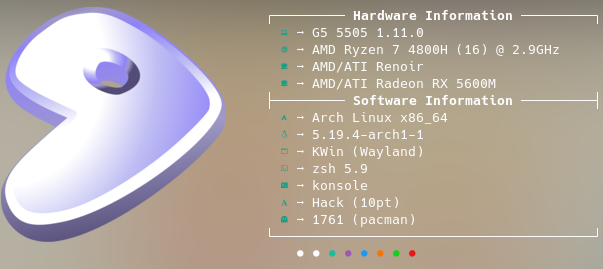

 There are [screenshots on different platforms](https://github.com/fastfetch-cli/fastfetch/wiki)
## Installation
### Linux
* Debian / Ubuntu: Download `fastfetch-
There are [screenshots on different platforms](https://github.com/fastfetch-cli/fastfetch/wiki)
## Installation
### Linux
* Debian / Ubuntu: Download `fastfetch-